2026 Central Florida Home Price Report by Neighborhood
Shirley Mancero August 6, 2026
Shirley Mancero August 6, 2026
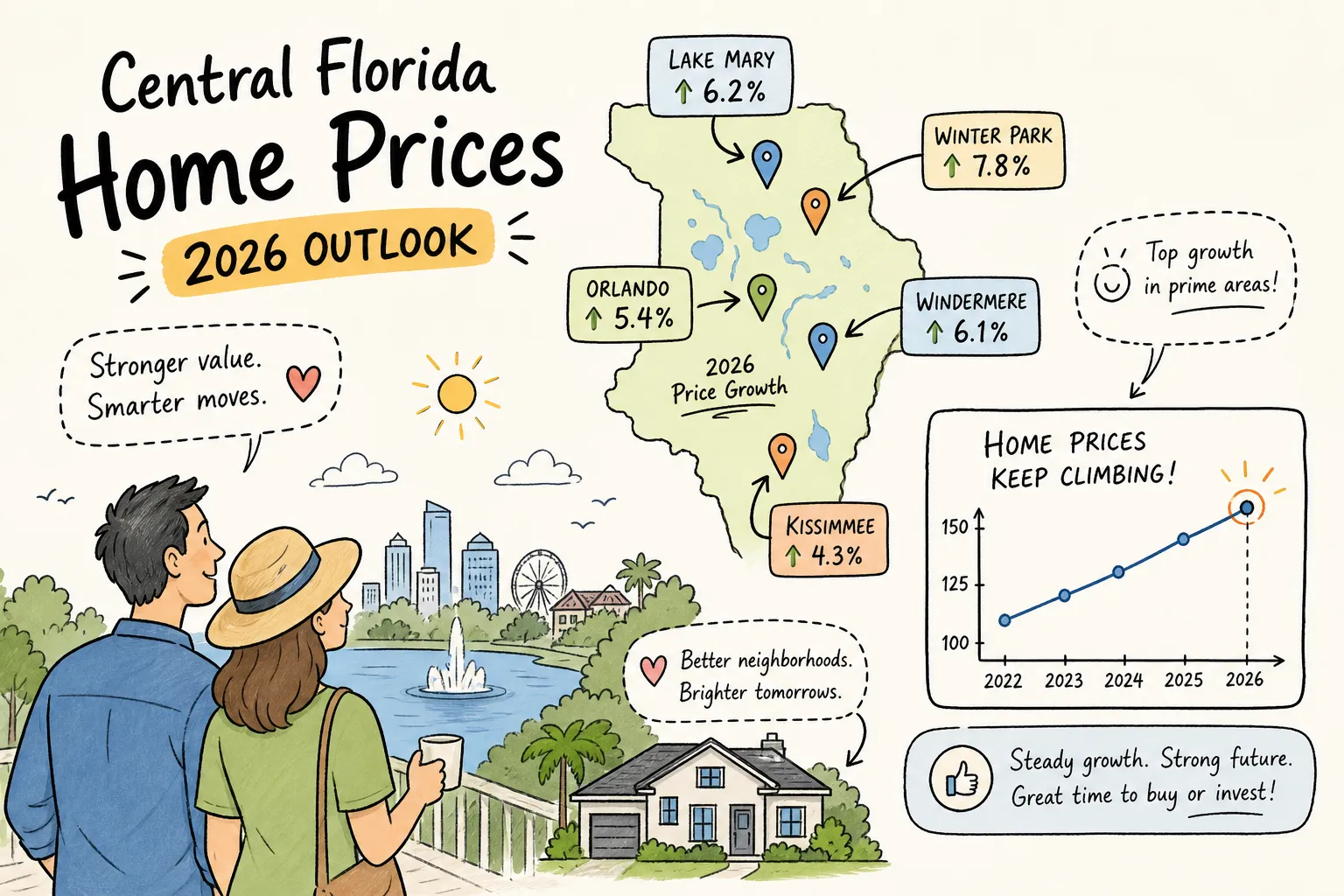
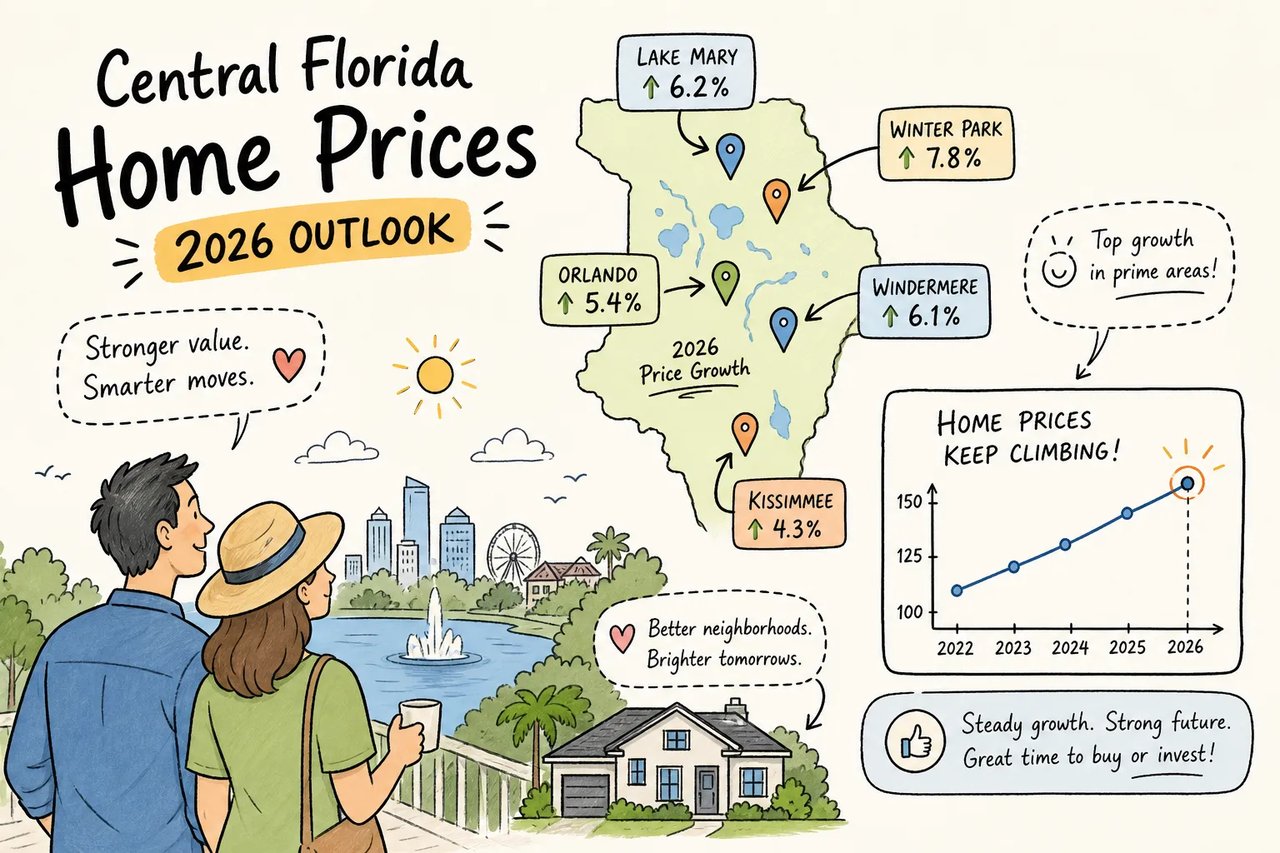
Central Florida home prices in 2026 vary sharply by ZIP code, and the gap between what you see on a real estate portal and what you'll actually pay or receive in a specific neighborhood can run into the tens of thousands of dollars. Redfin's May 2026 figure puts the Orlando metro median sale price at $409,755. That number gets cited constantly, shared on social media, and used by buyers to decide whether they can afford a neighborhood. The problem is that it blends a $773,000 Dr. Phillips home with a $320,000 east Orlando starter and averages the result across five counties. That single figure tells you almost nothing useful about what you'll pay or receive at a specific address.
This report breaks Central Florida down by submarket: the Orlando core, Lake Nona, Winter Garden, Clermont, and St. Cloud. The data reflects median sale prices, year-over-year trends, inventory conditions, and a short-term price outlook for each area. Shirley Ann, The Fintech Agent, tracks neighborhood-level comps weekly as part of how she advises buyers and sellers, and the granular approach behind this report is the same one she brings to every consultation and listing strategy session.
Florida Realtors reports a statewide single-family median of $417,500 for 2026 year-to-date, up just 0.8% year over year. Redfin's Orlando metro figure of $409,755 reflects a -2.0% YoY change, and Realtor.com's 2026 forecast projects a -1.6% price change for Orange and Osceola counties specifically. Those three numbers look similar on the surface, but they measure different geographies, different property types, and different time windows. Put them side by side and what you see is a region that is essentially flat to slightly negative, not crashing, but not appreciating either.
Orange County alone contains neighborhoods priced from the low $300,000s in parts of east Orlando all the way past $750,000 in Windermere and Doctor Phillips. Averaging those together produces a number that doesn't accurately describe any single buyer's or seller's reality. A seller in Windermere who prices to the county average leaves money on the table. A buyer in Celebration who uses the county average to set expectations walks into negotiations with the wrong number. ZIP code-level data is what actually drives sound pricing decisions, and it's where the real story of Central Florida home prices in 2026 becomes clear.
As of May 2026, Central Florida has roughly 13,957 active homes on the market, 5.47 months of supply, and an average of 68 days on market. Inventory is up approximately 34% over the past 24 months, near its highest level in over a decade. That shift explains why sellers can no longer count on the bidding wars that defined 2021 and 2022. The market has rebalanced, and buyers have more leverage than they have had since before the pandemic.
The table below anchors each submarket to the best available mid-2026 data. Figures represent typical or median sale prices for single-family residential properties. Clermont (34714) reflects a range drawn from two sources, Zillow's Home Value Index and local MLS median sale data, which accounts for the spread shown.
Submarket | Typical / Median Price | YoY Change |
|---|---|---|
Orlando metro (overall) | $409,755 | -2.0% |
Lake Nona | $725,000 | Stable / slight appreciation |
Winter Garden (34787) | $447,531 | +20.9% |
Windermere (34786) | $569,140 | +19.6% |
Clermont (34714)* | ~$406,000, $432,000 | -2.0% |
St. Cloud | $415,000 | Flat to slight softness |
*Clermont range reflects Zillow Home Value Index (~$406,000, $411,000) and local MLS median sale data (~$432,000). Both sources indicate a roughly -2.0% YoY trend.
The central Orlando market is the most internally fragmented in the region. The overall metro median of $409,755 sits well above pre-pandemic levels even with the year-over-year dip, but ZIP codes within Orange County tell very different stories. Doctor Phillips (32836) carries a typical home value near $773,898, and Baldwin Park (32814) sits around $766,216. Move to east Orlando and that same $400,000 budget buys significantly more square footage and lot size. If you are buying or selling in Orange County, the metro median is a starting point, not a pricing guide.
Lake Nona's median sale price sits around $725,000 as of May 2026, making it one of the most expensive submarkets in the metro. That price reflects the employment density around Medical City, the VA Medical Center, UCF Health, and the master-planned infrastructure that continues to attract out-of-state buyers. In-migration from households relocating for healthcare and tech employment has kept demand relatively steady here even as other parts of the region have softened. Lake Nona is not a first-time buyer market, but for move-up buyers and investors focused on long-term appreciation drivers, the employment fundamentals here rank among the strongest in Central Florida.
Winter Garden's ZIP 34787 recorded roughly +20.9% year-over-year appreciation with a typical home value near $447,531, making it one of the strongest-performing submarkets in the entire region. The neighboring Windermere ZIP (34786) shows a typical value of $569,140 with +19.6% YoY growth. The common threads between these two communities are low resale supply, high-rated school districts, and strong demand from move-up buyers leaving more urban ZIP codes. West Orange County is the clearest seller's market within Central Florida right now, and sellers here have more pricing power than virtually anywhere else in the metro.
Clermont's Zillow Home Value Index for ZIP 34714 shows values in the $406,000, $411,000 range, down approximately 2.0% over the past year, while local MLS data puts the median sale price closer to $432,000, a spread that likely reflects differences in data methodology and timing. St. Cloud's median sale price is closer to $415,000, with conditions described as flat to slightly soft. Both communities attract buyers seeking larger lots, newer construction, and more attainable entry points relative to the Orlando core. The trade-off is a longer commute to major employment centers, which keeps prices in check. For families prioritizing space and newer homes over proximity, these submarkets remain some of the most accessible in the region.
Montverde (34756) leads the local appreciation story with roughly +22.4% year-over-year growth and a typical home value near $468,211. Winter Garden and Windermere follow closely behind. All three share the same characteristics: constrained resale inventory, strong school district ratings, and buyer demand from households upgrading out of more urban or suburban ZIP codes. Geneva (32732) also shows solid appreciation at approximately +9.59% since 2023. These gains reflect constrained resale supply rather than speculative momentum, each of these communities has posted consistent absorption rates above the metro average, keeping upward price pressure intact.
Celebration and parts of the Kissimmee corridor (34747) reflect the weakest performance in the metro, with data showing approximately -8.89% since 2023 peaks. Oversupply of condos and townhomes, combined with high HOA fees, has pushed buyers toward alternatives in the same price range. Osceola County overall has underperformed Orange County, with home values essentially flat to slightly negative over the past 24 months. Sellers in these submarkets who price based on county averages or 2022 comps are routinely seeing longer days on market and price reductions.
Florida's 30-year fixed rates are clustered between 6.3% and 6.7% as of July 2026. At that level, the monthly payment on a $420,000 home is materially higher than it was at the 2021 lows, and that gap is the primary reason demand hasn't surged despite more inventory sitting on the market. Buyers are qualifying for less purchasing power per dollar of income, which narrows the active buyer pool at mid-range price points. Until rates move meaningfully lower, don't expect a sudden volume spike.
With supply at 5.47 months in May 2026, Central Florida is no longer a pure seller's market. The January 2026 reading was 7.19 months, so the spring selling season absorbed inventory meaningfully, but conditions are still closer to balanced than to the tight 2021, 2022 market. Days on market averaging 68 in May reflects homes sitting far longer than buyers and sellers were accustomed to over the past three years. Well-priced homes in strong locations are still moving, but overpriced listings are sitting, and price reductions are more common than at any point since before the pandemic.
Builder activity in Clermont, St. Cloud, and parts of Lake Nona gives buyers a credible alternative to resale inventory. When builders offer rate buy-downs and closing cost incentives, resale sellers in the same ZIP codes feel that competitive pressure directly. In Clermont, for example, new construction starts are advertised as low as $299,990 even as resale homes in the same city trade near $432,000. That spread limits upward price movement in otherwise healthy markets and gives buyers real negotiating room with resale sellers who aren't accounting for what builders are offering nearby.
Realtor.com projects a -1.6% median price change for Orange and Osceola counties through the rest of 2026. Zillow and Redfin's current data also reflect mild softness rather than recovery. The most plausible near-term scenario is price stabilization in the best-performing submarkets and modest declines in oversupplied areas like the Kissimmee corridor. If mortgage rates ease toward the mid-5% range by late 2026, sales volume will likely rise before prices do, rate relief tends to unlock buyers faster than it moves prices upward.
Sellers in west Orange County, specifically Winter Garden and Windermere, have more pricing power than sellers anywhere else in the metro right now. Sellers in Osceola County are in a different position entirely and need to price to current comps, not 2022 peaks. Buyers have more negotiating room than at any point since 2019, particularly on condos and townhomes with high carrying costs. Investors focused on long-term rental income should concentrate on ZIP codes anchored by employment drivers, specifically the Lake Nona medical corridor and southwest Orange County, where tenant demand is structurally supported by job growth.
A buyer budgeting $430,000 who only sees the Orlando metro median might assume they have solid options across the region. But in Winter Garden, that budget puts them right at the submarket median, not comfortably above it. A seller in Celebration who prices to an Orange County average risks overpricing by a significant margin because their specific submarket has been softening for two years. The gap between county-level data and ZIP-level reality isn't a minor rounding issue. It's the difference between a well-negotiated deal and a costly pricing mistake.
This is the work Shirley Ann, The Fintech Agent, does before every buyer consultation and listing appointment. She pulls active, pending, and sold comps at the ZIP code level, then filters by property type, square footage, lot size, and condition before building a pricing range grounded in real comparable sales. Her background in data modeling and database administration means she isn't guessing at market patterns, she's reading them the same way a fintech analyst reads a dataset. For buyers and sellers who want that level of precision, the difference between a data-driven approach and a gut-feel estimate from a county average can be tens of thousands of dollars.
Central Florida home prices in 2026 are not moving in one direction. West Orange County neighborhoods are still appreciating at rates that outperform almost any other major metro submarket in Florida. Parts of Osceola County are pulling back. Lake Nona is holding firm on employment-driven demand. And the regional median you see on a real estate portal is almost certainly not the right benchmark for your specific address, budget, or timeline.
Inventory is higher than it has been in over a decade. Rates are keeping affordability stretched. The next six months will most likely favor well-priced homes in strong employment corridors while oversupplied submarkets continue to see buyer-friendly conditions. Whether you're buying, selling, or deciding whether to wait, the right data starts at the ZIP code level, not the county level.
Shirley Ann, The Fintech Agent, offers hyper-local market analysis tailored to your specific neighborhood and goal. That could mean a CMA before listing, a neighborhood price report before making an offer, or a data-backed investment analysis for a rental property. Contact Shirley Ann directly to get the submarket-level numbers that actually apply to your situation.
Stay up to date on the latest real estate trends.


Work with Shirley Ann The Fintech Realtor®, for trusted residential real estate guidance in Orlando, FL. She combines integrity, local market expertise, multilingual communication, and data-driven strategies to help buyers, sellers, and investors achieve their real estate goals with confidence.