Pros and Cons of Buying New Construction in Central Florida
Shirley Mancero August 6, 2026
Shirley Mancero August 6, 2026
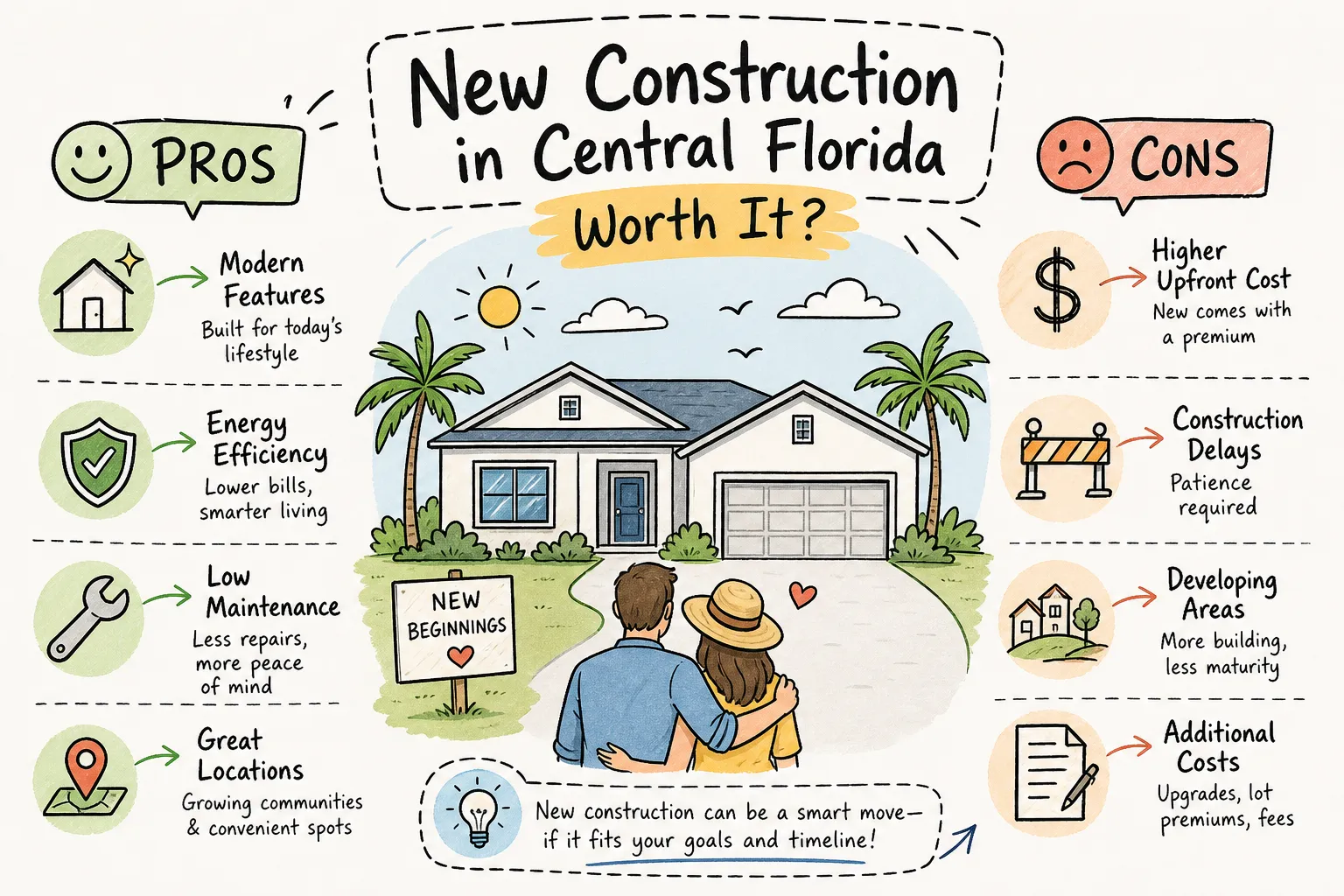
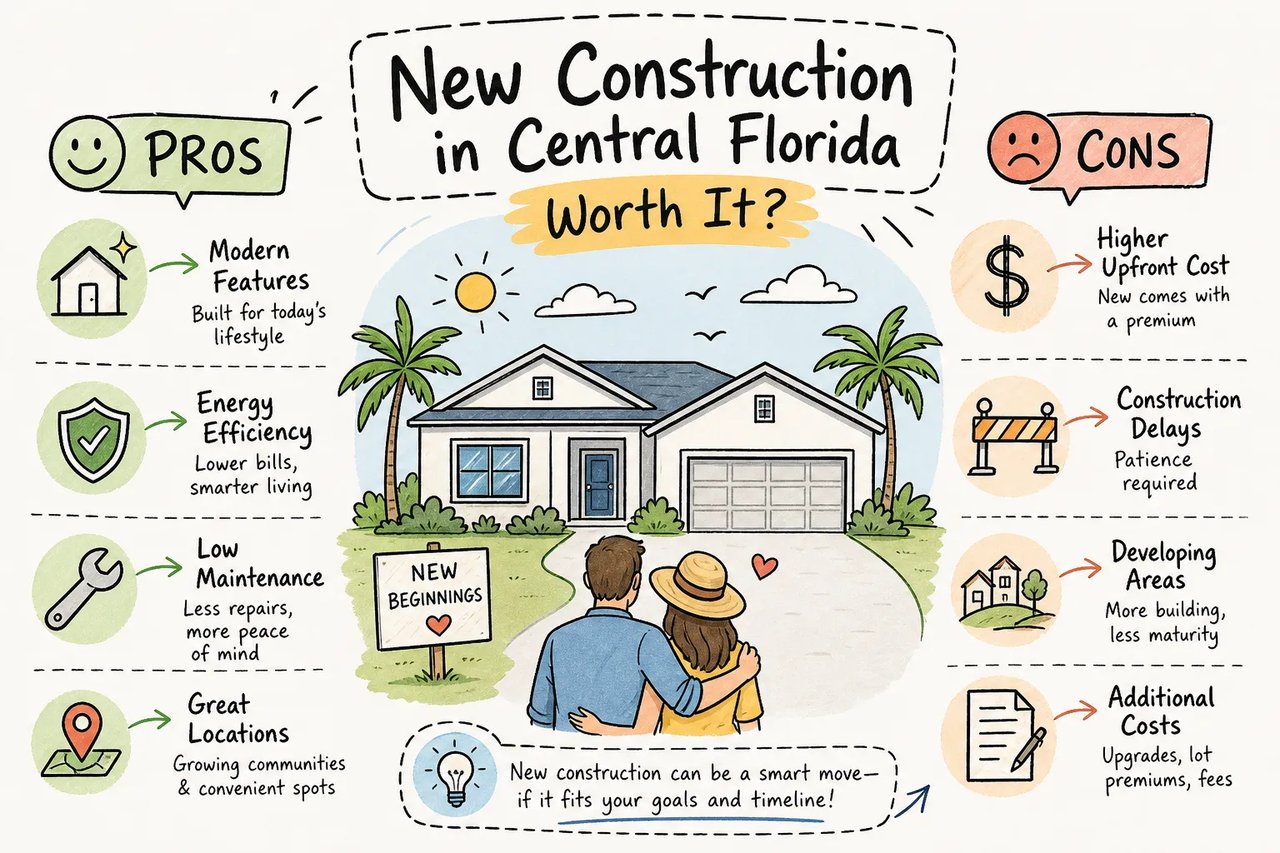
What are the pros and cons of buying new construction in Central Florida? If you're asking that question, this guide gives you an honest, data-forward answer. Walk into a model home in Winter Garden or Lake Nona and the appeal hits you immediately: quartz countertops, an open-concept layout, a smart-home panel by the front door. Everything is clean, current, and yours to configure. New construction homes in Central Florida have drawn steady buyer interest, especially as builders like Lennar, Pulte, and D.R. Horton continue opening communities across Horizon West, Sunbridge, and the Osceola corridor at a serious pace.
But that starting price on the brochure is not the price you pay. Not even close. The advertised base price is where the conversation begins, and buyers who don't understand what gets added between signing a contract and sitting at the closing table often end up surprised by how wide the gap is. This article is an honest breakdown of what new construction actually delivers, what it actually costs, and how to decide whether it fits your situation in 2026.
The buyers who navigate this best are the ones who bring real market data into the model home alongside their enthusiasm. That means running side-by-side comparisons across both new builds and resale homes in the same zip codes and school districts before any contract is signed, the kind of analysis that changes the conversation entirely.
The design center process is one of the most compelling parts of buying a new build in Florida. Builders typically allow buyers to choose flooring, cabinetry, countertops, fixture finishes, and layout options, and many now offer smart-home packages as part of their standard or upgrade tiers. Contrast that with buying a resale home, where what you see at the showing is what you get, and changing anything requires cash out of pocket after closing.
The tradeoff is real, though. Design center choices add money to your contract, and not every upgrade holds its value equally in resale. Structural options tend to appraise better than cosmetic finishes, and some high-markup items, like custom cabinetry or premium tile, may not return their full cost when you eventually sell.
Florida law provides a one-year statutory warranty for newly constructed homes, covering defects that amount to a material violation of the Florida Building Code. Most production builders layer a broader structure on top of that: one year for workmanship, two years for mechanical systems (HVAC, plumbing, electrical), and ten years for major structural defects through private warranty programs.
What buyers miss are the exclusions. Appliances fall under manufacturer warranties, not the builder's. Normal settling, homeowner-caused damage, and acts of God are all excluded. Florida frequently experiences tropical storms and hurricanes, making that last exclusion especially important to understand when you're standing in a model home in June and feeling the pull of the floor plan.
New construction in Florida genuinely does cost less to insure than older homes in many cases. Statewide data puts the average homeowners insurance premium for a new build around $4,233 per year, while comparable older homes statewide can reach $8,772 to $10,831 depending on age, with some insurers quoting premiums up to 50 percent lower for newer construction because of modern wind mitigation features and current building codes. It's worth noting that Central Florida existing-home premiums can vary significantly by submarket, so get local quotes rather than relying solely on statewide averages.
The important caveat: flood insurance is priced based on location and flood zone designation, not home age. A brand-new home in a high-risk flood zone still carries the same flood exposure as any other property on that lot. In Central Florida, flood insurance can run from under $500 per year in low-risk areas to $2,000 to $6,000 or more in high-risk zones, based on NFIP rate structures and private market pricing in the region.
The advertised base price is where the number starts, not where it ends. Builders charge lot premiums on top of the base price for corner lots, pond views, cul-de-sac positions, and anything considered a desirable location within the community. In active Central Florida communities, Pulte lot premiums run roughly $30,000 to $60,000 for standard lots and $115,000 to $160,000 for water or canal positions. Meritage shows a similar spread, with standard lots around $6,000 to $30,000 and lake lots reaching $250,000.
Design center upgrades typically add another 10 to 20 percent to the contract price. Run those numbers and a Central Florida new build that advertises at $450,000 often closes between $495,000 and $720,000 once lot premiums and upgrades are included. Comparable resale homes in the same metro currently sit around $410,000 to $416,000 based on 2026 market data. That gap, often $50,000 to $200,000 or more, deserves serious attention before you configure anything at the design center.
New construction comes with closing-cost line items that resale buyers rarely see. Budget for all of the following:
Total closing costs for new construction in Florida regularly fall between 2 and 5 percent of the purchase price, and in communities with heavy developer fees, that range can push higher. Budget accordingly before you fall in love with a floor plan.
Most production builders in the region estimate 7 to 12 months from contract signing to closing. Custom and semi-custom homes stretch to 14 to 18 months. The pre-construction phase, covering permitting and site preparation, happens before the clock on those estimates even starts. What buyers need to understand is that a builder's projected timeline is an estimate, not a commitment. If you have a lease ending or a current home to sell by a specific date, that timing risk is real and not trivial.
Florida's summer storm season routinely pauses construction activity. Permit and inspection backlogs at county offices add weeks. Material lead times have remained unpredictable through 2025 and into 2026. Buyer-initiated change orders reset timelines from the point of the change. Any one of these factors can push a projected closing by weeks; a combination can push it by months.
Delays in Central Florida are common and should be planned for. The practical consequence: rate locks on construction loans have expiration windows, and extending them costs money. Temporary housing while you wait has a real monthly cost. Some buyers end up paying for two places at once when a lease doesn't align with a delayed closing date. Building a buffer into your timeline plan is not pessimism, it's just accurate planning.
Resale makes sense for buyers who need a defined closing date, want to negotiate repairs or seller credits, and prefer to buy into an established neighborhood with mature landscaping and a known HOA track record. The all-in price is often lower even after accounting for light renovation, and Central Florida's resale inventory has shifted meaningfully through 2025 and into 2026, giving buyers more negotiating room than they had two years ago.
New construction makes the most sense for buyers who want a specific floor plan, need modern energy efficiency, and can absorb timeline risk without it creating a housing crisis. Buyers planning to hold the property long-term benefit most from the combination of lower near-term maintenance costs and current building standards. Builder financing incentives are also worth factoring in: Central Florida builders are currently advertising permanent rate buydowns in the 5.25 to 5.75 percent range, with closing-cost credits of $10,000 to $30,000 depending on the builder and community.
Read those incentive terms carefully. Builder financing offers apply only when you use the builder's preferred lender, and the overall loan terms, including rate, fees, and closing costs, need to be compared against outside financing before you assume the incentive is a good deal.
Inside a model home, the only comparisons the builder's sales representative makes are between floor plans in their own community. A local agent runs a comparative market analysis across both new construction homes in Central Florida and comparable resale homes in the same zip code or school district. That analysis tells you whether the all-in new build price actually represents value, or whether a resale home two miles away offers the same square footage for significantly less. It is the difference between shopping and making an informed decision.
Shirley Ann, The Fintech Agent, brings that analytical framework to every new construction conversation. With a background in data modeling and database administration combined with extensive experience in Central Florida real estate, she produces the kind of side-by-side pricing and community analysis that no model home tour provides on its own.
Builder contracts are written to protect the builder. The language around delay clauses, upgrade lock-in periods, earnest money forfeiture, and inspection rights is not written with the buyer's interests as the priority. A buyer's agent reviews that language before you sign and recommends independent third-party inspections at key construction phases, including framing and pre-drywall, which the builder's own inspector does not provide.
In many new construction transactions, the builder or seller offers compensation to the buyer's agent, which means buyers typically pay nothing directly for that representation. Confirm the arrangement with your agent upfront, but in most cases, skipping representation costs far more than using it. The financial risk of navigating a builder contract without an advocate on your side is real.
Get answers to these questions before a contract is on the table:
How a builder answers these questions tells you a great deal about how transparent they intend to be throughout the build.
Financing a new build requires specific questions your lender needs to answer upfront:
Understanding the pros and cons of buying new construction in Central Florida means looking past the model home. The advantages are real: modern design, builder warranty coverage, lower insurance costs in many cases, and meaningful financing incentives from builders competing for buyers in 2026. But the base price balloons with lot premiums and design center upgrades, hidden closing fees add up faster than most buyers expect, and construction timelines routinely slip by weeks or months. None of that makes new construction the wrong choice, it makes it a choice that deserves full information before you sign.
The buyers who come out ahead are the ones who run the full numbers on both sides of the market before committing. That means a comparative market analysis covering new construction homes in Central Florida and resale homes in the same area, a line-by-line review of the builder contract, and a lender conversation that isn't filtered through the builder's preferred financing team.
Shirley Ann, The Fintech Agent, does exactly that work for buyers across the Orlando metro, from Lake Nona to Winter Garden to Windermere and beyond. If you're weighing a new construction purchase against resale options in Central Florida, reach out for a side-by-side comparison before you configure a single upgrade. The data will tell you what the model home won't.
Stay up to date on the latest real estate trends.


Work with Shirley Ann The Fintech Realtor®, for trusted residential real estate guidance in Orlando, FL. She combines integrity, local market expertise, multilingual communication, and data-driven strategies to help buyers, sellers, and investors achieve their real estate goals with confidence.